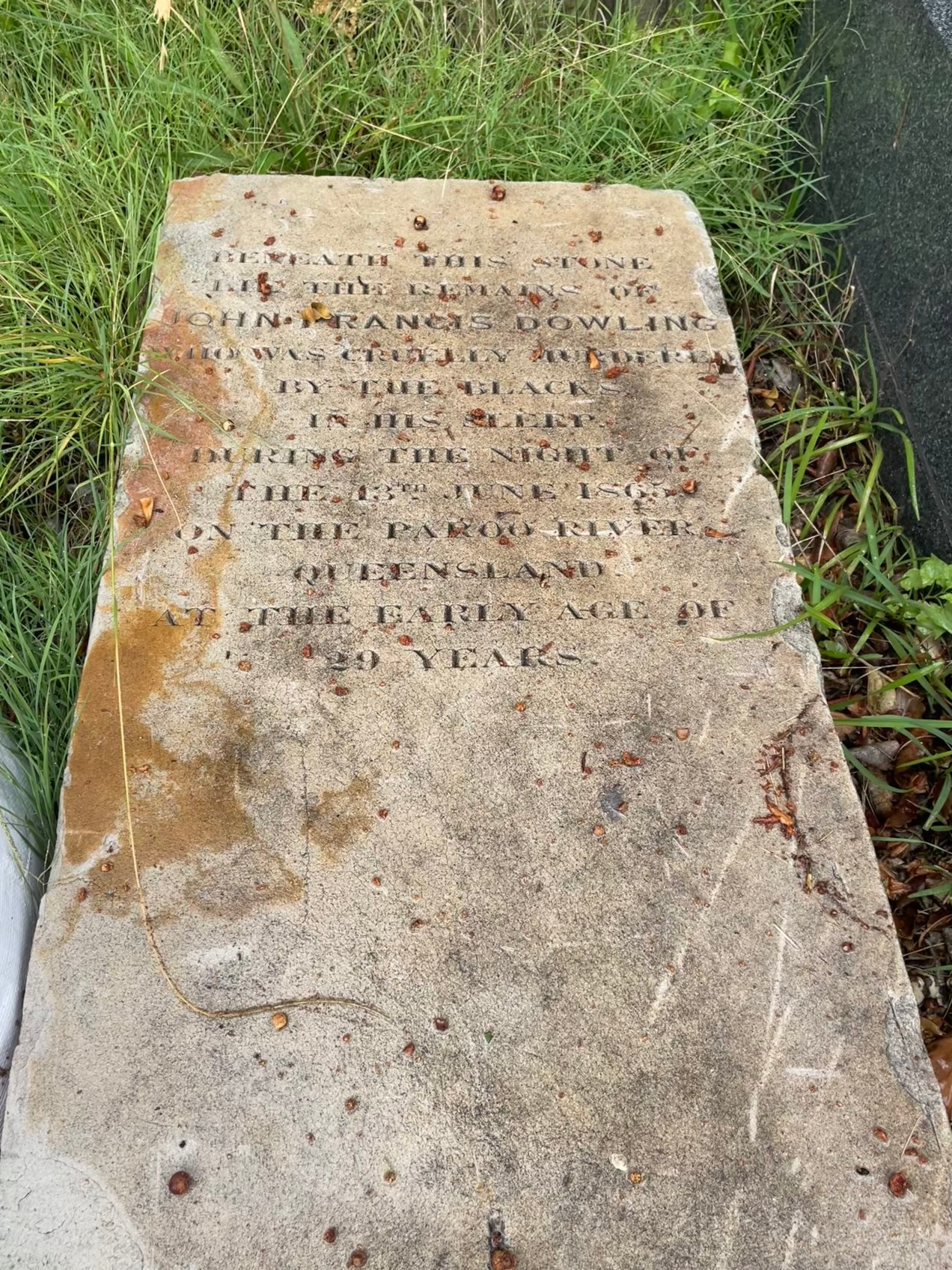
In 2019, I published The Murder of John Francis Dowling and the Massacre of 300 Aborigines. By a letter dated 14 March 2025, I was informed by the minister of the Anglican parish of St Jude’s Randwick, Sydney, which has a remarkable historic cemetery behind the church, that a great sandstone slab had been discovered. It was the gravestone of a John Francis Dowling.
The inscription states: Beneath this stone lie the remains of John Francis Dowling who was cruelly murdered by the Blacks in his sleep during the night of the 13th June 1865 on the Paroo River Queensland at the early age of 29 years.
The tombstone inscription is consistent with Dowling’s death certificate, which is not surprising, and is an additional piece of physical evidence that John Dowling was killed on the Paroo River and not the Bulloo River. On 5 July 2017, the Colonial Frontier Massacres in Australia 1788-1930 website was launched. The ABC proclaimed without critically examining the site that “Now a landmark project mapping those massacres has hit a sobering point — 250 sites have been documented across almost every state and territory.” In 2019, the site declared with great authority that between 1 Jan 1865 and 31 Dec 1865 at Thouringowa Waterhole, Bulloo River, 300 Aboriginals were killed: “Following the killing of Ardoch station owner John Dowling (on the Bulloo River), his brother Vincent led a posse of settlers including EO Hobkirk and set out in revenge and found the Kullila camped on the eastern side of the river and chased them towards the Grey Range, shooting them down as they ran. McKellar says the posse was led by the native police and that 300 were killed.”
I my book of 2019, I conclusively proved that John Dowling was murdered on the Paroo River by the Blacks and that there was no massacre of Blacks on the Bulloo River by Vincent Dowling or any other person or persons. The Massacre website of 2025, now records that between 1 Jan 1865 and 31 Dec 1865 at Thouringowa Waterhole, Bulloo River, 30 Aboriginals were killed. That is a 90% reduction. No explanation is given for the reduction. My book of 2019 is now cited in the sources. However, the Massacre website still persists with the allegation that a massacre occurred at the hands of Settler(s), Stockmen/Drover(s).
The tombstone is beyond doubt a relic to rival any historic gravestone to be found within the churchyards of England. It is a find to be treasured and preserved for future generation of Australians.
The Murder of John Francis Dowling and the Massacre of 300 Aborigines by Paul Dillon, ISBN 9781925826500 Paperback, 124 pages, $29.95 available from Connor Court Publishing, Brisbane.
 Paul Dillon Commentator and Author